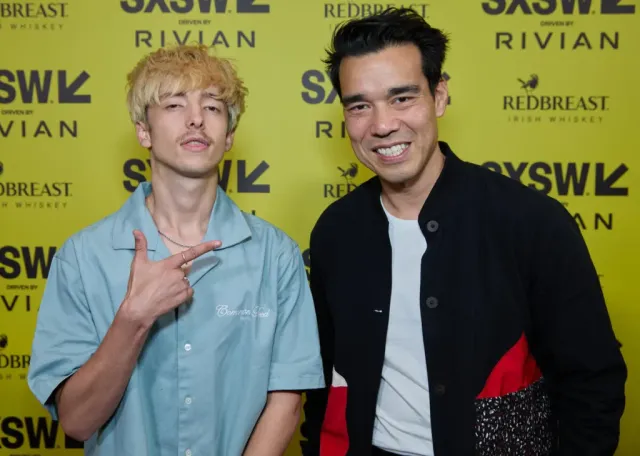
Brian: The title of Leviticus carries a lot of weight. What drew you to the tile and what themes or ideas from that resonated with the story you wanted to tell?
Adrian Chiarella: We wanted to tap into where this history of homophobia comes from, particularly in western society. It was something for those of us who grew up with a lot of religion around us. It does carry a lot of weight, as you say, in the queer community. So, it was something that came from that. But it was also something where we wanted to have sort of a lot of biblical imagery and references throughout the film, because that is where, as I said, this sort of source of homophobia came from. We also wanted to sort of question how much of these kinds of edicts about how to live our lives, how much of that comes from the universe, and how much is that stuff that we put on each other. So, that’s where that came from. We did, interestingly, have a scene where we explained that, where we had the pastor character, [Nicholas Hope], give a little speech, where he quoted The Book of Leviticus, but it literally felt preachy. It was actually quite late in the process that we took it out and I feel like we all feel like the film is a lot stronger for that.
Brian: I was curious. I think most films about faith or morality kind of lean towards clear answers, but I think Leviticus doesn’t really seem interested and is kind of more interested in the gray areas. Was that ambiguity something you intended or is it built into the story?
Adrian: It was very much something that we intended. I think I like to let the audience fill the gaps themselves a lot, both narratively and also in terms of the message and the themes of the film. I think it’s always so much more resonant if you can do that so people can take their own meaning away. So, that was always very important to me. I think that ending, you know, so many people have come up to me and given me their own versions of the ending, and it always means something to them individually. I feel like the best ending for a film leaves people with that little bit of space where they have to imagine what it is that’s happening to characters. That’s always so much better than anything that the best filmmaker in the world could have shot.
Brian: No, I agree. I think endings, like the one in this film, are better because you leave the movie theater kind of with your own thoughts more and I think that really helps. So, now for you, Joe, your character carries a lot of emotion. What was your entry point to understanding him when you first read the script?
Joe Bird: When I first read the script, I think what stood out to me most was how authentic and raw these characters were, every single character. I think my character, Naim, had a specific relationship with each character in the film and I think it was just kind of finding the points. I kind of like to think of movies sort of like an album, and you know, the singing through a different track and I think, “how can I cohesively go from track one to two to then track three?” Working with Adrian was a dream. There’d be a scene and he’d go, “alright, think back to when you were in the context of this character.” I kind of liked the way that Adrian would direct me, because I just kind of got it. We had an intimacy coordinator around to make sure when things were intense, we could not be fully enthralled, into whatever sadness or depression or whatever horrors were going on. I just really supported my other castmates and all the crew, it never felt like it was ever going too much.
Brian: That makes sense. Adrian, I think the atmosphere in this film feels really deliberate. So were there particular filmmakers of films that influenced, or the tone that you were aiming for?
Adrian: We wanted to sort of point to a lot of classic American horror, like John Carpenter, and movies like The Thing, Halloween, The Nightmare on Elm Street films were a big influence for me. But also a lot of horror from Japan and Korea were a big influence on this as well. I don’t think that’s kind of niche, I think a lot of us who enjoy the genre have been watching a lot of horror from Asia. So, we did have a lot of little nods to horror from Japan as well and the references to that. That was a big part of it too. The music was inspired by a lot of the sounds that you hear in that sort of John Carpenter era of horror films, with that sort of electronic and synth work that was starting to come into films from that era, and we put that in there. But, at the same time, Jed Kurzel, our composer, also weaved a lot of very organic sounds into it as well to make it feel part of the world that this film is set in.
Brian: I think music, especially in horror films, can make or break the film. Because the music has to set the tone and the mood, and the mood that you want the audience to feel. So, again, the right score and the right music always takes a horror film to another level, at least in my mind.
Adrian: Yeah. We sort of had two palettes with the score. We had the sort of love story and we had the horror story elements. It was how those two sounds kind of dovetail where we really kind of explored some interesting stuff. We kind of had the sound of this romance between the boys that would sort of break and crack in the soundtrack and that was really fun to do.
Brian: This question is for both of y’all. What was the most challenging scene for you all to shoot and what made it difficult?
Joe: I think maybe the most challenging scene to film would probably be the last sequence of the fight in the warehouse. There were a lot of moving parts, and then to get it on the day. We had such great stunt team working out, and everyone on the crew, because it was towards the end of the shoot, we just kind of knew how to work with each other. What was on paper, the most challenging thing, still challenging, but everyone worked so harmoniously together that it just kind of came together.
Adrian: For me, shooting the bus scene was really hard, only because doing intimacy is always a big ask of you’re actors, but also then doing it on a moving vehicle, and you’re trying to have a closed set on a moving vehicle, which is actually very difficult to do. You kind of have to section up one part of the bus. But, we had our amazing intimacy coordinator, who did a really great job with you guys and you guys did a really good job. Once we were off and running, I think everyone felt like we could get it done.
Brian: I figured y’all’s answers would be different; as a director, what you shot and as an actor, what you shot. I figured both y’all both saw was totally different. When you look at the finished film now, is there a scene that surprised you the most and how it evolved from the script to the screen?
Adrian: I really love this one, there’s this one little moment, it’s almost a throwaway moment, there’s just a bit of improv between Joe and Stacey [Clausen] near the beginning of the film. It was the last day of shooting and it was something that we came up with because I think we knew this film was only going to work, both in terms of the love story and horror story, if you really cared about these two characters. It was just one of those things where you get to the last day of shoot and think, “Oh, I wish the whole movie was this”, but at the same time, it obviously just fit for what it needed to do.
Brian: This is for both of y’all. I want to know, during the making of Leviticus, what was a moment where the film challenged your own beliefs or assumptions about the characters, other themes, or even yourselves? Did that change how you approached the rest of the project?
Joe: Very good question, I must say.
Adrian: It is a very good question, actually.
Joe: I wouldn’t say I really had any beliefs influenced while filming this film. But, I think I did notice that everyone, kind of in the crew and the cast, understood what we were making, that this was a queer love story. Everyone was very respectful of wanting to make this film right. It’s a strong message. It’s also a bit of a political message, I’d say, a kind of commentary on homophobia. It was very nice to see that everyone was in support of making this film be the best it can be and think, “this is a queer film and we want everyone to see it for what it is and enjoy it for what it is.
Adrian: I have a similar answer. I think when we were shooting the scene where Marine [Tyallah Bullock] drops you home, to the deliverance killer and how difficult that was to shoot in terms of understanding why someone would do that to their own child. I remember a couple of people on the crew had a bit of a chat with me about how things in their own experience were still happening to people who they knew, or relatives that they had. There was always times while I was making this film, where I thought, “Is this even relevant anymore? Is this even an issue for queer people growing up?” I had to be reminded every now and then that it really is. And still, I think now we’ve started showing the film to people over here, I do get a lot of comments from people saying they face issues like this everyday, whether they’re younger audiences or older audiences.
Brian: Depending on the state where you live. There are some states that are more likely to do something like what versus others. Seeing that scene, I’m old enough to know people who have stories like that. I don’t understand how people can do that, especially the people that they love.
Adrian: It was funny, when we were talking to me about how to do it, it was sort of something you wouldn’t do, like how did we think of this? We [Tyalla] agreed she would think of it like she was dropping someone off to be kind of sectioned for others, like it had nothing to do with weirdness or anything like that. It was a really tough one.
Joe: The funniest thing about that scene though is in between each of those takes, we were just singing “Doo Wop (That Thing) by Lauryn Hill (Everyone laughs) And then we go straight into her sending me off to conversion camp, big change of emotions.
Brian: Last question for y’all. Films like this often leave audiences sitting with difficult questions rather than answers. What conversations do you hope viewers are having as they walk out the theater?
Adrian: The film speaks quite loudly about what it has to say about homophobia and those direct issues. I hope people have conversations about their own relationship with fear, whatever it is that is holding them back in their own lives from being their truest self.
Joe: Yeah. I think when people watch this, as someone who is creative, you just want someone to be inspired by what you’ve made and whether that inspires them to talk to one of their friends with, “how are you? What’s going on?” or just checking in. Whether it’s something more drastic, like telling a family member off for being homophobic or something like that. If one small thing can come out of it, then we’ve done our job.
Member of the North Texas Film Critics Association, and lover of all things Cinema
Brian Taylor
Member of the North Texas Film Critics Association, and lover of all things Cinema